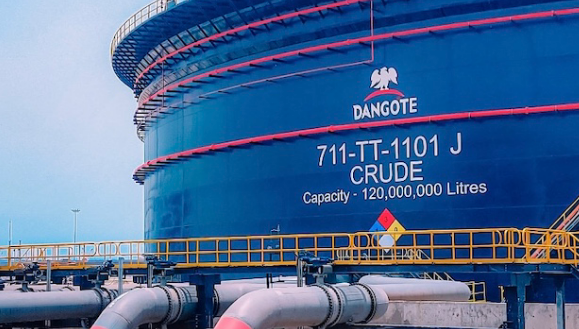
Jet fuel exports from the Dangote Petroleum Refinery have increased by about 770 per cent over the past two years, reflecting surging global demand for aviation fuel and the plant’s expanding production capacity, according to an analysis of shipment data from Kpler.
In parallel, the Nigerian National Petroleum Company Limited (NNPC) reported a five-year high in crude oil trading volumes under its current management, highlighting what it described as major operational gains across Nigeria’s energy sector in the last year.
Data reviewed from Kpler shower a dramatic transformation in the global aviation fuel market, with the Dangote Refinery evolving from a new regional facility into a major global supplier within just two years.
By April 2026, the refinery’s jet fuel exports had reached a record 158,000 barrels per day (bpd), compared to about 18,000 bpd in April 2024.
This represents a 770 per cent increase over the period.
At the start of operations in 2024, exports to Europe were absent as the refinery focused on test runs and regional supply.
However, by April 2026, shipments to Europe had risen to around 70,000 bpd, marking strong expansion into one of the world’s most competitive aviation fuel markets.
Industry dynamics, particularly the ongoing conflict in the Middle East, have contributed significantly to this shift.
European airlines and fuel distributors are increasingly seeking alternatives to Gulf supplies, with West Africa seen as a more stable and shorter shipping route.
The African market has also recorded significant growth. Deliveries rose from 18,000 bpd in April 2024 to 69,000 bpd in April 2026, representing a 283 per cent increase.
In the last 12 months alone, shipments to neighbouring African countries reportedly more than doubled.
The refinery had been filling supply gaps previously met by imports from Europe and Asia, helping to reduce logistics costs and stabilize fuel availability for regional carriers.
The Americas have remained a fluctuating but important destination.
Exports to the region rose from 19,000 bpd in June 2024 to a peak of 55,000 bpd in February 2025, before easing to about 14,000 bpd by April 2026 as supply priorities shifted toward higher-value European contracts.
Despite the recent decline, the earlier surge represented a 189 per cent increase at its peak, showing the refinery’s ability to redirect output in response to global market conditions.
The Red Sea crisis and wider geopolitical tensions have also reshaped global shipping routes.
Longer and riskier journeys from the Persian Gulf to Europe have increased costs for traditional suppliers, while shipments from Lagos to Europe reportedly take nearly half the transit time and avoid high-risk waters.
Kpler data further showed that between December 2025 and April 2026, total jet fuel exports from the refinery nearly doubled, rising from 81,000 bpd to 158,000 bpd, a 95 per cent jump in four months.
Smaller but growing shipments to emerging markets in South America and Asia have also risen from zero in early 2024 to about 19,000 bpd by April 2026.
Meanwhile, the Nigerian National Petroleum Company Limited said crude oil trading volumes reached a five-year peak of 1.71 million barrels per day in its latest One-Year Mandate Report covering April 2025 to April 2026.
The report outlined several milestones across upstream, gas, and downstream operations. Its exploration subsidiary, NEPL, achieved a record production peak of 365,000 bpd in December 2025.
The company also announced the resolution of the long-standing OPL 245 dispute, converting the asset into a new Production Sharing Contract to attract further investment.
In the gas sector, NNPC confirmed completion of the Ajaokuta-Kaduna-Kano (AKK) pipeline River Niger crossing and welding works in July 2025, while reporting gas supply levels of 7.5 billion standard cubic feet per day for the period under review.
It also highlighted its partnership role in the Dangote Refinery, including the implementation of the crude-for-naira arrangement and acquisition of a 7.25 per cent equity stake in the facility.
Other developments included the introduction of a new crude grade, Cawthorne, expansion of its Oleum lubricant brand across West Africa, and improved transparency measures such as its first-ever earnings call and reinstated monthly performance reports.
The company said it has also resumed consistent monthly remittances to the Federation Account since July 2025.
According to Group Chief Executive Officer Bayo Ojulari, the reforms reflect a broader push to reposition the organisation.
“Over the past year, we have delivered steady progress against our mandate, with measurable results across production, financial performance, infrastructure, and organisational culture.
“But this is more than a report on targets met.
”It is a statement of accountability to every Nigerian. At NNPC Limited, we are committed to leading with purpose, putting our best foot forward to build a more prosperous and sustainable energy future for our country, ” he said.