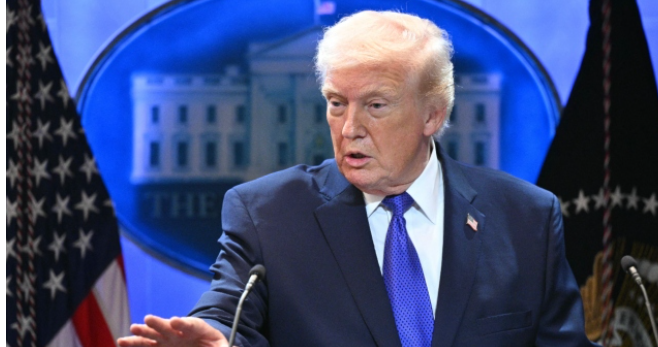
United States President Donald Trump has announced that the United States will begin assisting stranded vessels in the Strait of Hormuz from Monday, in what he described as a coordinated maritime operation aimed at restoring movement through the strategic waterway.
In a post shared on social media, Trump said: “For the good of Iran, the Middle East, and the United States, we have told these Countries that we will guide their Ships safely out of these restricted Waterways,” though he did not specify which nations would benefit from the operation.
He warned that any interference with the initiative referred to by him as “Project Freedom”, would be met with force.
Iran has sharply restricted navigation through the Strait since the outbreak of conflict in February, while the United States has also imposed a naval blockade on Iranian ports, escalating tensions in the region.
Reacting to the announcement, senior Iranian lawmaker Ebrahim Azizi, a former commander in the Islamic Revolutionary Guards Corps, said any American intervention would be treated as a breach of the ceasefire.
“Any American interference will be considered a violation of the ceasefire,” he wrote on social media, ” he said.
Trump also suggested that diplomatic engagement with Tehran was ongoing, describing talks as “very positive” and saying they “could lead to something very positive for all.”
He said the operation would serve as a “humanitarian gesture” on behalf of the United States and other regional stakeholders, though he did not identify the countries involved. Details of coordination with Iran were not provided.
“The Ship movement is merely meant to free up people, companies, and Countries that have done absolutely nothing wrong,” Trump added, insisting vessels would remain in place until navigation becomes safe.
According to the U.S. Central Command, the operation would involve about 15,000 personnel, guided-missile destroyers, and more than 100 aircraft under the “Project Freedom” framework.
Reports indicated that an estimated 20,000 sailors have been stranded in the Gulf since the conflict began, raising concerns over supply shortages and worsening living conditions at sea.
Tensions in the region escalated further after the United Kingdom Maritime Trade Operations reported that a tanker was struck by an “unknown projectile” in the Strait on Sunday, though crew members were confirmed safe.
Trump’s announcement also followed reports from Iranian state-linked media that Tehran had received a U.S. response to its latest peace proposal, delivered through Pakistan, and was reviewing it.
Washington has not formally confirmed the exchange.
Iran’s proposal reportedly calls for the withdrawal of U.S. forces near its borders, an end to the naval blockade, and a broader ceasefire that includes Israel’s operations in Lebanon, with a 30-day timeline for agreement.
Iranian officials maintained that nuclear talks are not currently underway, with foreign ministry spokesman Esmaeil Baghaei stating, “at this stage, we do not have nuclear negotiations.”
Tehran continues to deny any intention to develop nuclear weapons, insisting its programme is peaceful despite enrichment levels close to weapons-grade.
Trump, however, struck a sceptical tone, saying he could not support Iran’s proposal.
“They have not yet paid a big enough price for what they have done to Humanity, and the World, over the last 47 years,” he said.
He added that while he had reviewed the outline of the proposal, he was awaiting the final wording.
Asked about possible military action, he said strikes inside Iran “could be a possibility” if conditions deteriorate.
“If they misbehave.
”If they do something bad,” he said, while also insisting the United States would remain engaged in the conflict to prevent future escalations.