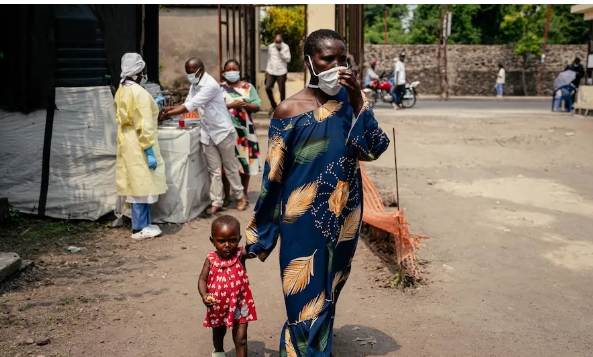
Uganda has shut its border with the Democratic Republic of Congo (DRC) as authorities intensify efforts to contain a rapidly expanding outbreak in eastern Congo, where suspected infections are nearing 1,000 cases.
The decision was announced on Thursday by Uganda’s National Task Force on Ebola Response, which said the measure became necessary due to rising concerns over cross-border transmission between the two neighbouring countries.
Uganda and the DRC share long and highly active border communities, with frequent trade and movement across multiple entry points in East and Central Africa, increasing the risk of disease spread.
Health authorities in Uganda confirmed that the country recently recorded its first Ebola case linked to the ongoing outbreak.
The infected individual, a Congolese national, reportedly crossed into Uganda while seeking medical treatment.
Officials said the patient later died on May 14 in intensive care in Kampala after developing severe haemorrhagic symptoms consistent with Ebola infection.
Following the latest restrictions, Ugandan authorities stated that movement across the border will now be tightly controlled.
Only essential categories such as authorised Ebola response teams, humanitarian workers, security personnel, and approved cargo and food transport operators would be permitted to cross.
The government said the new measures are part of a broader regional containment strategy aimed at preventing additional imported cases as surveillance is strengthened in high-risk areas.
Health agencies continue to monitor the situation in eastern DRC, where case numbers are rising and response teams are working to slow further transmission across affected communities.
The outbreak has renewed concern across the region due to the highly contagious nature of the virus and the difficulty of controlling spread in densely connected border populations.
Officials said enhanced screening, movement restrictions, and cross-border coordination will remain in place as long as transmission risks persist.