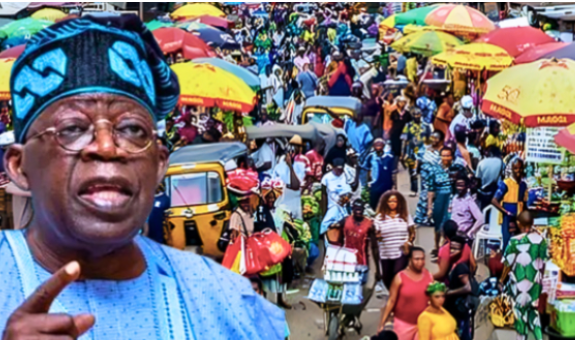
President Bola Tinubu has reiterated that the decision to remove fuel subsidy shortly after assuming office saved Nigeria from a looming financial crisis and set the nation on a path toward economic recovery.
The President made the remarks during a meeting with state governors who paid him a visit in Lagos to celebrate the Sallah festivities and commemorate the third anniversary of his administration in office.
According to a statement issued by the Special Adviser to the President on Information and Strategy, Bayo Onanuga, governors from several states joined the gathering.
Among those present were the governors of Lagos, Nasarawa, Jigawa, Sokoto, Kebbi, Taraba, Niger, Ekiti, Delta, Ondo, Edo, Adamawa, Benue, Enugu, Ogun and Kogi, while the deputy governors of Borno and Kano also attended.
Tinubu reflected on one of the most consequential decisions of his administration, the removal of fuel subsidy announced during his inauguration on May 29, 2023.
The policy, which immediately ended government spending on petrol subsidies, sparked sharp increases in fuel prices, transportation costs and the prices of goods and services across the country.
The President acknowledged the hardship experienced by Nigerians following the move but maintained that the action was necessary to prevent the country from sliding into economic collapse.
He argued that for years, subsidy payments had consumed huge public funds that could have been invested in vital sectors capable of driving growth and development.
“It was challenging at the time, but we survived. We faced litigation and accusations.
”We survived them. Instead of bankruptcy, Nigeria has survived. The economy has recovered. It is growing. Agriculture is booming,” the President said.
Tinubu noted that his administration’s reforms across infrastructure development, agriculture, foreign exchange management, fiscal discipline and social investment programmes were beginning to produce positive results.
He said the measures had helped restore confidence among investors and improved the country’s economic outlook.
The President assured Nigerians that his government would remain committed to policies designed to ease economic pressure on citizens. He said efforts would continue to focus on job creation, food security, social welfare and inclusive economic growth.
Speaking on relations between the Federal Government and the states, Tinubu praised governors for supporting his reform agenda and helping to maintain public confidence during a difficult transition period.
According to him, increased revenue allocations to states following subsidy removal have strengthened their financial position, enabling them to meet salary obligations, reduce reliance on loans and embark on development projects.
“I’m glad governors are no longer borrowing from the federal government and asking for interventions and not knowing how to survive, how to pay salaries, no more. You kept the spirit, you kept the hope,” he stated.
“You persuaded our people to be patient and endure these three years of painful reform, during which we put the economy on a reset. Today, the benefits are showing,” he added.
Tinubu further stated that key economic indicators were showing signs of improvement.
He pointed to ongoing infrastructure projects, including road construction and housing schemes, which he said were either being revived or completed across the country.
The president also expressed confidence in the future of the agricultural sector, stressing that Nigeria has the potential to attain food self-sufficiency if available land resources are effectively harnessed.
Vice President Kashim Shettima, who attended the event, commended Tinubu’s leadership and described the subsidy removal as a courageous step toward addressing deep-rooted challenges within the oil and gas sector.
According to Shettima, the administration chose to confront difficult realities rather than postpone decisions that had long hindered economic progress.
Also speaking, Chairman of the Nigeria Governors’ Forum and Governor of Kwara State, Abdulrahman Abdulrazaq, said the policy had significantly boosted revenues available to state governments.
He explained that the increased funds had enabled many states to clear outstanding salary and pension obligations while investing more heavily in infrastructure and social programmes.
Abdulrazaq added that state governments were becoming less dependent on borrowing and suggested that authorities consider a new national minimum wage benchmark of N100,000.
Similarly, Chairman of the Progressive Governors Forum and Governor of Imo State, Hope Uzodinma, praised the administration’s reform efforts.
He said the measures introduced over the past three years had helped stabilise the country and prevent a deeper economic crisis.
Uzodinma noted that governors had reviewed the performance of the administration and expressed satisfaction with the progress made so far.
Earlier, Lagos State Governor Babajide Sanwo-Olu welcomed his colleagues to Lagos for the Sallah celebration and thanked them for their continued support of the Federal Government’s policies and programmes.
The gathering served as an opportunity for the administration to reflect on its three years in office, with government officials maintaining that economic reforms initiated since 2023 are beginning to yield measurable gains despite the challenges experienced during the transition period.