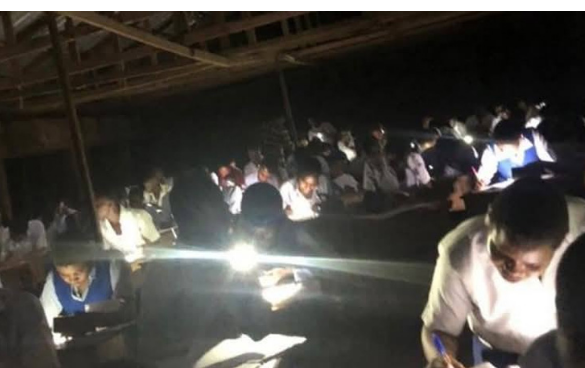
The 2026 West African Senior School Certificate Examination (WASSCE) has come under heavy criticism following widespread delays in the delivery of examination materials, which forced candidates in several centres across Oyo, Lagos, Ogun and Osun states to sit for papers late into the night, in some cases using torchlights, mobile phone flashlights and solar-powered lamps.
The examination disruptions reportedly began on Monday when candidates were made to wait for several hours before eventually sitting for the Physics Essay and Objective papers, originally scheduled for 2pm and 3:30pm respectively.
The delays persisted on Wednesday, with the General Mathematics Objective paper starting at about 6:30pm in some centres and as late as 8:30pm in others. Many candidates reportedly did not complete their papers until after 10pm.
The situation was especially severe in parts of Ibadan, Oyo State. Although the first batch of the Agricultural Science practical was slated for 2pm and the second batch for 3:30pm, some centres were still yet to begin the exercise by around 8pm.
As a result, candidates were forced to write under poor lighting conditions.
A viral video circulating on social media showed students using torchlights, mobile phone flashlights and solar-powered lamps to complete their examinations, triggering widespread outrage online.
One X user, Mariam Kehinde, said her sister remained at the examination centre late into the evening due to the delays.
“What exactly is happening in this country sef? My sister left for her WAEC exam since morning and still hadn’t returned home,” she wrote.
“She called around 6pm saying their exam paper had just arrived at that time nitori olorun. She was still at the exam centre, and my mum even had to wait.”
Another user, Adedeji Adeyinka, described Thursday’s conduct as deeply troubling.
“Candidates writing Government completed the Theory paper and were instructed to wait for the Objective paper, only for the question paper to arrive more than FOUR HOURS later,” he said.
“How is this acceptable in a national examination? Even more shocking was the situation faced by students writing Agricultural Science Practical.
An examination scheduled for 2:00 p.m. did not commence until about 9:00 p.m. in many parts of Oyo State.
“A seven-hour delay is not a minor inconvenience. It is a systemic failure.”
Another X user, Mum Ire, complained about shortages of examination materials during the Mathematics paper on Wednesday.
“Out of 75 candidates, only 35 Mathematics question papers were brought to the examination centre for the entire exam yesterday,” she wrote.
“When did WAEC start operating like this?
“Now we are being told that the Agriculture Science practical questions are on the way at 8:10 pm.”
Joel Abodunrin also raised concerns about inadequate question papers.
“WAEC’s been doing well until today,” he wrote.
“An examination hall of about 250 candidates and having Mathematics question papers for only 120.
“Getting to tear the questions into pieces so that all could have something to do.”
Hakeem Olaoye said candidates were forced to write examinations at unreasonable hours.
“WAEC exam being conducted late in the evening.
“The Agric practical exam that was supposed to be held by 2pm just commenced some minutes after 7pm,” he said.
“Very disheartening indeed. Likewise for Mathematics. A school with 130 students was given 16 question booklets to share among.”
The incidents have raised safety concerns, as many candidates remained at centres long after nightfall.
Speaking to TheCable, Moyosola Adesina, Head of Public Affairs at the West African Examinations Council Nigeria, said the body would soon issue an official statement addressing the complaints.
Reacting to the development, President of the National Association of Nigerian Students (NANS), Akinteye Azeez, described the situation as unacceptable and dangerous.
“It is both appalling and condemnable that young Nigerians, who had already endured months of preparation and the mental rigours associated with external examinations, were subjected to unnecessary hardship by being kept at examination centres far beyond reasonable hours,” he said.
“No examination procedure, administrative challenge, or operational deficiency should come at the expense of the safety and fundamental rights of students.”
He added that the situation was particularly alarming given rising security concerns in the South-West.
“What makes this development even more alarming is the fact that it occurred within the South-West region, a zone that has, in recent times, witnessed incidents of kidnapping, crime and other security challenges,” he said.
“Against this backdrop, it was grossly irresponsible for examination authorities to permit circumstances that left students stranded or lingering at examination centres late into the night, thereby exposing them to potential danger.”
He called for a comprehensive review of WAEC’s logistics and contingency measures.
“Students must never become victims of administrative failures, poor planning or institutional negligence,” he added.
The 2026 WASSCE began on April 21 and is scheduled to end on June 19.