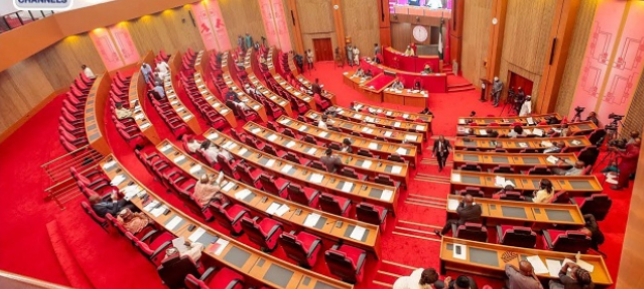
Senate Leader Opeyemi Bamidele has disclosed plans to introduce a constitutional amendment bill in the 11th National Assembly that would replace Nigeria’s current two-term presidential and governorship tenure structure with a single six-year term.
He said the proposal is part of a broader constitutional reform agenda aimed at improving governance efficiency and reducing the distractions associated with re-election politics.
Bamidele made the disclosure during an extensive interview in Abuja, where he also spoke on issues bordering on constitutional amendments, national security, legislative transparency, and the performance of the 10th Senate.
According to him, a single six-year term would allow elected leaders to focus fully on governance without the pressures of political campaigns and succession battles.
The Senate Leader also called on the Revenue Mobilisation Allocation and Fiscal Commission (RMAFC) to publicly disclose the salaries, allowances, and benefits of all political office holders in Nigeria.
He argued that persistent public misconceptions about lawmakers’ earnings stem from a lack of transparency by the commission constitutionally responsible for determining political remuneration.
Bamidele maintained that legislators neither fix nor control their pay and insisted that full disclosure would help correct widespread public assumptions about their earnings.
“All allowances received by parliamentarians at both the federal and state levels should be published fully and publicly. Legislators do not determine their remuneration,” he said.
He added that such disclosure should cover members of the National Assembly, state legislators, ministers, and other categories of public office holders.
Bamidele also clarified that official vehicles provided to lawmakers are government property assigned for legislative and constituency duties, and not personal assets.
On security matters, the Senate Leader defended the upper chamber’s decision to reject a motion seeking a special probe into military expenditure in the fight against insurgency and terrorism.
He said such an investigation during active military operations would undermine troop morale and national security efforts.
According to him, the Senate already exercises oversight through its Defence, Army, Navy, and Air Force committees, which regularly monitor procurement and expenditure processes.
He stressed that some aspects of military operations must remain confidential due to security considerations.
Despite concerns over renewed attacks in some parts of the country, Bamidele insisted that progress was being made in the fight against terrorism.
He attributed recent incidents to pressure on insurgents, who he said have resorted to retaliatory attacks as military operations intensify.
“We must not allow political interests or propaganda to weaken public support for our military. Significant progress is being made, even if much of it cannot be discussed openly,” he said.
On legislative reforms, he reaffirmed support for capital punishment for convicted kidnappers and said an anti-terrorism bill he sponsored was nearing final passage.
Bamidele also dismissed claims that the 10th Senate operates as a rubber stamp of the executive, arguing that the legislature engages in constructive collaboration rather than confrontation.
He said many disagreements with the executive are resolved through consultations before reaching the Senate floor, citing the recent tax reform bills as an example of effective legislative engagement.
Reflecting on the performance of the 10th Senate, he described the suspension of a female senator as one of its lowest moments, noting that it attracted negative public attention.
However, he maintained that the Senate has recorded significant achievements in economic reform, taxation, education, agriculture, and institutional development.
He expressed confidence that the reforms already passed by the National Assembly would, over time, strengthen Nigeria’s economy and improve citizens’ welfare.