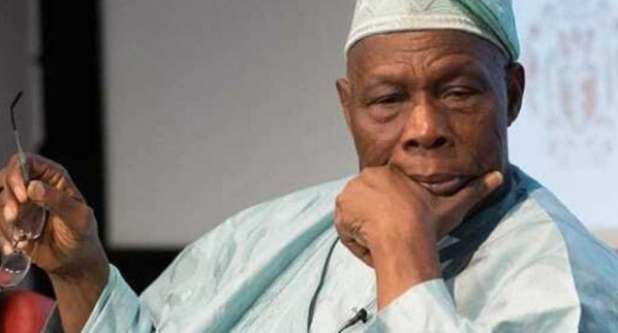
Former President Olusegun Obasanjo has raised fresh concerns over Nigeria’s unity, warning that many of the political, ethnic and social issues that triggered the country’s civil war between 1967 and 1970 remain unresolved.
Speaking on Wednesday in Abeokuta, Ogun State, during the unveiling of a historical publication on the Asaba Massacre at the Olusegun Obasanjo Presidential Library, the former Nigerian leader cautioned that the nation must never allow history to repeat itself.
Obasanjo stressed that regardless of differing opinions or political interests, Nigeria cannot survive another civil war.
He urged leaders and citizens to confront the country’s lingering divisions through dialogue, justice and national reconciliation instead of allowing them to escalate into another conflict.
Recalling a past conversation with former Head of State, General Yakubu Gowon, Obasanjo said Gowon had once warned that Nigeria might not survive a second civil war.
According to him, that warning remains relevant today, making it imperative for Nigerians to learn from history and work collectively to preserve peace.
The former president noted that understanding painful chapters of the nation’s past is essential to preventing future tragedies.
He explained that documenting historical events allowed present and future generations to appreciate the consequences of hatred, intolerance and political violence while embracing the collective responsibility of ensuring such events never occur again.
Obasanjo, who served as a military commander during the civil war, admitted that he could not provide firsthand details about the Asaba Massacre because military operations in the area were under the command of the late General Murtala Muhammed.
He, however, pledged to study the newly presented documents and audiovisual materials to gain deeper insight into the incident.
He also recounted intervening to stop acts of misconduct by some soldiers during the war, including preventing the attempted rape of a woman in Asaba, saying discipline remained an important responsibility of military commanders even in wartime.
Author of the historical work, Chief Chuck Nduka-Eze, described the publication as one of the most comprehensive accounts of the Asaba Massacre, drawing from eyewitness testimonies, archival records, interviews, audiovisual evidence and historical research.
According to him, available evidence shows that after federal troops entered Asaba, civilians were gathered in public places and instructed to publicly declare loyalty to Nigeria by chanting “One Nigeria.
”Despite complying, many unarmed men were reportedly separated from women and children before being killed.”
He said multiple independent accounts consistently point to the deaths of more than 1,000 civilian men, describing the massacre as one of the darkest episodes of the Nigerian Civil War and a painful scar in the nation’s history.
Nduka-Eze further warned that many of the underlying problems that fueled the civil war—including ethnic suspicion, mistrust and division—still exist today.
He called for sincere national healing, justice and stronger unity to prevent future conflicts.
The event ended with renewed appeals for Nigerians to preserve the lessons of history, promote peaceful coexistence and commit themselves to ensuring that the country never experiences another civil war.