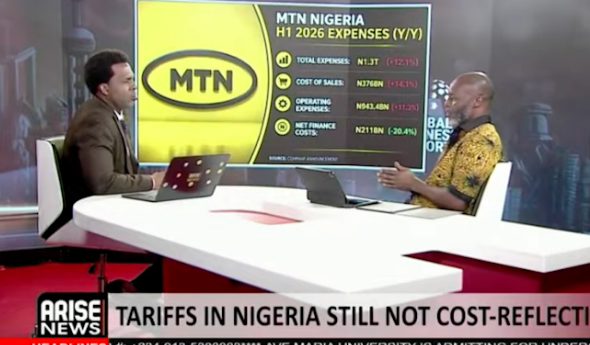
MTN Nigeria’s Chief Financial Officer, Modupe Kadri, has clarified that the company’s widely reported three trillion figure represents revenue generated through its operations and contribution to Nigeria’s economy, not profit.
Speaking during an interview with ARISE NEWS on Wednesday, Kadri explained that the amount reflects the value created through MTN’s telecommunications services, including voice, data, digital solutions, enterprise services and fintech offerings to more than 92 million subscribers nationwide.
“It’s the headline number, but it’s revenue, so it’s not profit. That represents the contribution to the economy through the provision of services, ” he said.
Kadri revealed that data services account for about N1.7 trillion of the company’s revenue, driven by growing smartphone adoption and increasing demand for digital connectivity.
He said MTN currently has about 55.6 million active data subscribers, with average monthly data consumption reaching nearly 15 gigabytes per customer.
“Nigeria has a youthful population and demand for digital services continues to grow, ” he said.
The CFO said the company has continued to invest heavily in expanding its network, disclosing that MTN spent more than N1.6 trillion on capital expenditure between January 2025 and the present period.
“That money has gone back into the network because demand just keeps increasing, ” he said.
However, Kadri noted that some service disruptions occur due to challenges beyond the company’s direct control, including fibre cuts, vandalism and restricted access to network facilities.
“You can make all the investments in the world, but if fibre cables are cut or sites are locked, those are issues outside our control, ” he said.
On rising operational expenses, he said inflationary pressures, particularly increasing energy, diesel and transportation costs, continue to affect the telecommunications sector.
According to him, MTN has introduced cost-efficiency measures to manage these pressures while maintaining service quality.
Speaking on competition within the industry, Kadri said MTN supports a competitive environment but stressed that competition must be sustainable to allow operators to meet their obligations and continue investing.
“Competition is good, but it has to be sustainable, ” he said.
He also emphasised the importance of appropriate telecommunications pricing, noting that tariffs must reflect the realities of maintaining and improving network infrastructure.
“Appropriate pricing encourages investment. At some point, tariffs will have to reflect the realities of sustaining and improving the network, ” he said.
Kadri further disclosed that MTN Nigeria has completely repaid its foreign currency-denominated loans, eliminating forex-related debt and reducing finance costs.
“We now have zero forex-denominated loans, and that has contributed to lower finance costs, ” he said.
He concluded that the telecommunications industry remained a major driver of Nigeria’s economic growth and called for continued support from regulators and policymakers to encourage investment and strengthen digital infrastructure.
“The telecom sector has to remain bullish because it is critical to the economy, ” he said.