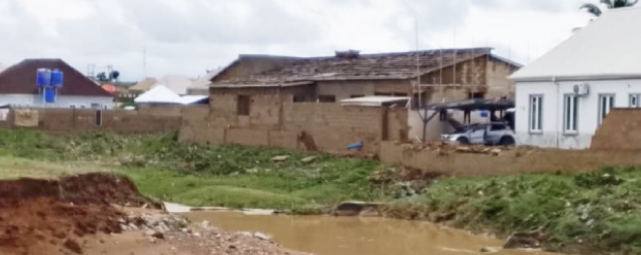
A flash flood has submerged several homes and destroyed property worth millions of naira at the General M.I. Wushishi Housing Estate in Minna, Niger State, leaving residents scrambling to salvage their belongings.
The flooding, which occurred in the first week of August, forced some residents from their homes as water reportedly rose to chest level in parts of the estate.
A correspondent of Hensard Times who visited the affected area, observed that residents were seen moving household items and other valuables to safer locations, while several houses remained inundated.
One of the victims, Waziri Ahmed, said the flood destroyed virtually everything in his home, including foodstuff, important documents, mattresses and livestock.
According to Ahmed, the rapidly rising water left residents with little choice but to evacuate their children and move to safer areas.
He appealed to the Niger State Government to provide urgent assistance to affected families, many of whom, he said, had lost valuable property and means of livelihood.
Another resident, Bamidele Ajayi, said floodwater entered her home and swept away her car and other belongings.
Ajayi said residents had been told that mining activities had interfered with the natural water channel in the area, causing water to back up into the residential community.
She called for decisive government action to address the recurring flooding, expressing frustration over repeated promises of intervention without a permanent solution.
Although no death was reported in the latest incident, residents urged the government to urgently clear blocked waterways, repair damaged drainage infrastructure and regulate activities capable of worsening flooding.
The Niger State Emergency Management Agency has advised residents living close to waterways, canals and riverbanks to move to safer and higher locations following the incident.
The Director of Relief and Rehabilitation at NSEMA, Yusuf Mohammed, gave the warning while inspecting the affected area and assessing the extent of the damage.
Mohammed described the incident as an unusual flash flood, noting that it occurred earlier than the period when the state typically experiences its most severe flooding.
He said the state had received warnings from climate and flood forecasting agencies about the possibility of heavy rainfall and flooding this year.
However, he acknowledged that the timing and intensity of the latest incident caught many residents off guard.
According to him, NSEMA had commenced sensitisation and public awareness campaigns across the state, particularly in communities located near canals and riverbanks.
He urged residents to remain alert and relocate whenever flood conditions posed a threat to their safety.
Mohammed explained that serious flooding in Niger State usually becomes more pronounced around late September and early October, making the August incident particularly concerning.
He also rejected suggestions that the M.I. Wushishi Housing Estate had never experienced flooding on such a scale, saying records showed that the estate and surrounding communities had suffered significant flooding in previous years.
The NSEMA official identified mining activities and inadequate drainage maintenance among the factors contributing to the worsening flood situation.
He explained that mining activities upstream had removed topsoil that would ordinarily absorb some of the rainwater, thereby increasing the quantity and speed of water flowing towards downstream communities.
Mining activities downstream, he added, had contributed to blockages in natural waterways, restricting the movement of floodwater.
Mohammed also pointed to the poor maintenance of existing drainage infrastructure, saying some sections of the canal had collapsed.
“What you are seeing in the background now is as a result of the bad flow of water that was blocked along this part by the activities of some of these miners,” he said.
He warned that the existing canal might not have the capacity to accommodate the volume of water expected as the rainy season progresses.
The NSEMA official consequently advised residents in vulnerable locations to relocate to safer areas where possible.
He also raised concerns about town planning violations, noting that some structures had been built too close to the canal and outside the boundaries of the original government-planned estate.
According to him, many of the structures affected by the flood were later developments erected outside the designated areas.
Mohammed further identified a collapsed fence at a bend in the canal as another factor that contributed to the flooding by obstructing the movement of water.
He appealed to the Niger State government to urgently assist residents whose homes and property were affected by the disaster and to take measures to prevent a recurrence as the rainy season intensifies.