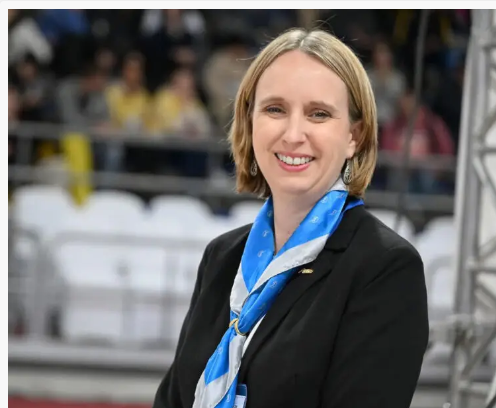
The President of the Fencing Federation of South Africa (FFSA), Louise Lombard, has expressed confidence in Nigeria’s preparedness to host the 2026 Commonwealth Fencing Championships.
Lombard gave the commendation in a statement issued on Sunday in Lagos ahead of the tournament scheduled for August 2026.
She said Nigeria had continued to demonstrate its capability to organise major international fencing competitions, adding that the country’s growing reputation in the sport inspired confidence among participating nations.
According to her, Nigeria’s experience in hosting previous international tournaments would play a significant role in delivering a successful championship.
“They have continued to grow and improve, so I expect it to be a quality event,” she said.
Lombard, who is also an administrator, Fédération Internationale d’Escrime (FIE) referee and former Secretary-General of the FFSA, noted that she had closely followed the development of fencing in Nigeria over the years.
She explained that the forthcoming championships would provide an important platform for emerging athletes, especially young fencers competing internationally for the first time.
“We are hoping for a competitive event where some of our fencers will gain their first international experience in a positive environment,” she said.
The South African fencing official, however, lamented the lack of recognition African fencing still receives from some established fencing nations across the world.
According to her, several leading countries continue to underestimate the progress being made by African nations in the sport.
“Unfortunately, many leading fencing countries are still ignorant of the growth and potential of African fencing and fail to show up and see what we can do.
“This is despite the fact that Nigeria has successfully hosted international competitions in the past,” she added.
Lombard expressed optimism that the 2026 Commonwealth Fencing Championships would further project Africa’s progress in fencing and improve the continent’s visibility within the global sporting community.
She disclosed that South Africa was planning to send a large contingent of athletes to Lagos, noting that veteran fencers in particular were enthusiastic about participating in the tournament.
While acknowledging the importance of medals, Lombard stressed that the primary focus for many young athletes would be gaining exposure and building confidence on the international stage.
“I will admit that medals are always a plus, but we will have many new international fencers, so a positive experience is the primary goal,” she said.
She also pointed to the forthcoming Youth Olympics in Africa as another opportunity for the continent to prove its ability to host world-class sporting competitions successfully.
“We have definitely seen new faces at competitions, so the growth looks good.
“We just need to keep showing that we can do it and the world will see,” she said.