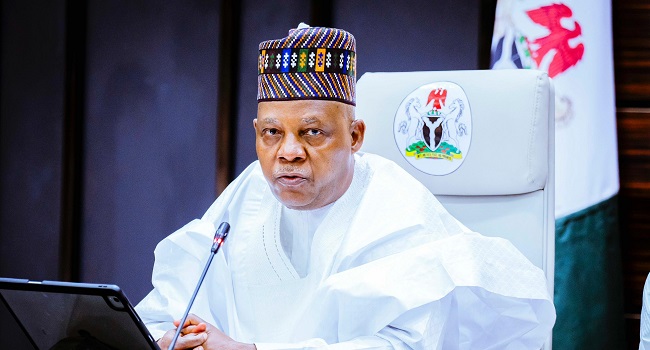
Vice President Kashim Shettima has called on African countries to take greater control of their natural resources and strengthen their position in global trade by moving from exporting raw materials to developing value-added industries.
Shettima made the call on Friday in Cotonou, Benin Republic, during an official tour of the Glo-Djigbé Industrial Zone (GDIZ), where he led a delegation of Nigerian governors to study the country’s industrial development model.
The Vice President said Africa’s vast resources provide an opportunity for economic transformation if governments embrace industrialisation, local production and strategic partnerships.
According to him, the continent must maximise its natural wealth to secure a stronger place in the global economy.
Shettima assured that Nigeria’s industrial drive under President Bola Tinubu’s administration would involve every region of the country, stressing that no area would be excluded from the renewed push for economic growth.
“As far as Bola Tinubu remains the President of Nigeria, no region will be left behind in the renewed industrialization drive of the Nigerian leader, ” he said.
He praised the Beninese government’s efforts in transforming agricultural resources into finished products for local consumption and export.
The Vice President expressed concern that Africa receives only a small share of the global value chain despite its resource advantage.
“Of the $370 billion worth of global cotton, Africa benefits from only about one per cent of that amount, ” he added.
He said Nigeria’s plan to revive its textile industry would create millions of jobs, boost non-oil exports and stimulate economic activities across the country.
After inspecting cotton, textile, cashew and soybean processing facilities at the industrial zone, Shettima said Nigeria would adopt lessons from Benin’s approach to agro-industrial development.
“We have learnt a lot of lessons through this visit and we are going to replicate a lot of that in Nigeria, ” Shettima said.
He disclosed that Nigeria is establishing eight agro-industrial zones across eight states as part of efforts to promote value addition and make the country one of the world’s industrial economies.
The Nigerian delegation was briefed on the structure and investment opportunities of GDIZ by Benin’s Minister of Tourism and Foreign Trade, Mr. Olushegun Adjadi Bakari.
The delegation toured facilities where locally produced cotton is transformed into yarn, fabrics and finished garments, while agricultural products such as cashew and soybean are processed for domestic and international markets.
The 1,640-hectare industrial platform, developed through a partnership between the Beninese government and ARISE Integrated Industrial Platforms, hosts textile, garment, cashew, soybean and other manufacturing businesses, with more than 25,000 jobs created since production began in 2021.
The visit was part of Nigeria’s efforts to learn from Benin’s success in connecting agriculture with manufacturing, attracting investment and turning raw materials into finished goods.
The governors accompanying the Vice President—AbdulRahman AbdulRazak (Kwara), Hope Uzodimma (Imo), Umar Namada (Jigawa), Umaru Dikko Radda (Katsina), Caleb Mutfwang (Plateau), and Dauda Lawal (Zamfara)—expressed readiness to explore similar industrial opportunities in their states.
They highlighted the potential of public-private partnerships, youth employment, technology transfer and stronger links between farmers and manufacturers.
To promote environmental sustainability, Shettima and the governors concluded the visit by planting trees within the industrial zone.