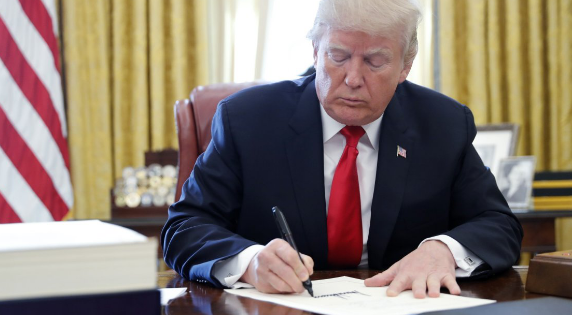
U.S. President Donald Trump has reopened his battle over birthright citizenship, signing two executive orders aimed at restricting automatic citizenship for some children born in the United States and cracking down on so-called birth tourism.
The move comes just weeks after the US Supreme Court rejected Trump’s earlier attempt to broadly roll back birthright citizenship, setting the stage for another potentially bruising legal confrontation over the meaning and limits of the 14th Amendment.
Speaking from the Oval Office, Trump defended the latest measures and criticised the court’s earlier decision.
“This should have happened years ago, but we’re taking care of it now,” Trump said.
The first order seeks to narrow the circumstances under which children born in the U.S. to non-citizen parents would automatically receive citizenship.
It targets specific categories, including cases involving parents connected to foreign terrorist organisations or foreign governments, people accused of attempting to obtain citizenship through fraud, and certain circumstances involving U.S. territories.
The second order focuses specifically on birth tourism—the practice in which pregnant foreign nationals travel to the United States intending to give birth so their children can acquire U.S. citizenship.
Trump and members of his administration have repeatedly portrayed the practice as an abuse of America’s immigration system.
White House presses birth tourism case
White House Deputy Chief of Staff for Policy and Homeland Security Adviser Stephen Miller argued that some foreign visitors enter the country under the guise of tourism when their actual purpose is to give birth.
“The idea (is) that people come here pretending to be a tourist, pretending to be a visitor,” Miller said.
He argued that the resulting citizenship gives children access to rights and benefits that the administration believes should be reserved for Americans.
The administration’s claims about the scale of the practice, however, have attracted scrutiny.
Trump has spoken of hundreds of thousands of babies being born in the U.S. through birth tourism, but estimates from the nonpartisan Migration Policy Institute are substantially lower, putting the annual figure at roughly 22,000 to 26,000 births.
The institute has also cited government data showing 9,600 births in 2024 to mothers whose addresses were outside the United States.
Legal experts therefore question whether birth tourism represents the kind of widespread phenomenon suggested by the administration.
University of California, Davis law professor Gabriel Chin described it as “a drop in the bucket” compared with the millions of births recorded annually in the United States.
The central challenge for the administration is whether the president can accomplish through executive action what the Supreme Court has already rejected.
Trump’s original attempt, issued after he returned to the White House in 2025, sought to deny automatic citizenship to children born in the U.S. to certain non-citizen parents.
That policy was challenged in court, culminating in a Supreme Court ruling in June that reaffirmed broad birthright citizenship and dealt a major blow to Trump’s effort to change the longstanding policy.
Trump sharply criticised the judgment at the time.
“Our country suffers because of it, and we’re ending it a different way,” he said.
The new orders take a narrower approach, but legal scholars say that may not shield them from constitutional challenges.h
Chin said the government could have authority to restrict entry by people who seek to travel to the US specifically to give birth.
But he questioned whether the president could subsequently deny citizenship to a child once that child had been born on American soil.
“Once a child is born in the United States, I don’t think the president has any power to decide that that child is not a citizen,” he said.
Other legal experts have similarly warned that the latest measures could run into the constitutional protection of birthright citizenship.
Reuters reported that the new attempt faces an uphill legal battle despite being narrower than Trump’s previous order.
The latest orders demonstrate that the Trump administration is unwilling to abandon one of its most controversial immigration objectives even after a major Supreme Court setback.
For the White House, targeting birth tourism and narrowing citizenship eligibility is part of a wider effort to tighten America’s immigration system and redefine who can acquire citizenship automatically.
For opponents, the issue goes much deeper.l
They argue that the 14th Amendment establishes a broad constitutional guarantee that cannot simply be rewritten through presidential action.
That clash is now likely to move back into the courts, where judges will have to determine whether Trump’s latest strategy represents a lawful use of executive power or another attempt to circumvent constitutional protections.
For millions of immigrant families, the outcome could determine how the United States interprets one of its most fundamental citizenship principles.