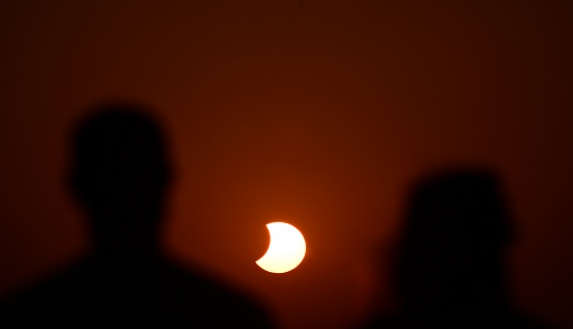
Western Iceland was plunged into darkness on Wednesday as the Moon passed directly between the Earth and the Sun, producing a rare total solar eclipse that drew thousands of residents and visitors despite heavy cloud and rain.
The dramatic celestial event reached totality over Keflavík, about 50 kilometres southwest of Reykjavík, at 5:47pm local time, temporarily turning day into night.
For Reykjavík, the eclipse carried special significance as it was the first total solar eclipse visible from Iceland’s capital since 1433.
The rare spectacle prompted visitors from across Iceland and beyond to converge on viewing locations, with accommodation booked out in several parts of the country well ahead of the event.
Although anticipation had built for years, many spectators in western Iceland were unable to see the Moon completely cover the Sun because thick clouds and rain obscured the sky.
Astronomer and science communicator Sævar Helgi Bragason was among those who had eagerly awaited the occasion. He said he had spent more than a decade looking forward to the eclipse after witnessing a partial eclipse over Iceland in 2015.
But the unfavourable weather forecast left him torn between anticipation and disappointment.
“I’ve been waiting for this day for more than 10 years,” he said before the eclipse.
Describing his feelings as a mixture of “excitement and heartbreak”, Bragason added: “It’s almost like I’ve lost someone.”
Despite the poor conditions, the eclipse still transformed parts of the country as darkness swept across the landscape during the brief period of totality.
The longest period of complete darkness occurred around the cliffs of Látrabjarg, in Iceland’s westernmost region, where totality lasted approximately two minutes and 13 seconds.
In central Reykjavík, the Moon blocked the Sun completely for just over a minute.
The event also generated a significant tourism rush. Hotels across Reykjavík and other parts of Iceland were reportedly fully booked, with some visitors making reservations many years in advance.
Iceland’s national broadcaster, RÚV, reported that a hotel in the western village of Breiðavík received its first booking for the eclipse as far back as 14 years ago.
The eclipse was visible in varying degrees across parts of Europe, but Iceland’s position along the path of totality made it one of the most sought-after destinations for spectators hoping to witness the rare phenomenon.
For those fortunate enough to catch glimpses through breaks in the clouds, the moment offered a spectacular reminder of the extraordinary alignment of the Sun, Moon and Earth.
For others, the darkness itself became the defining memory of an eclipse that had been anticipated in Reykjavík for nearly six centuries.