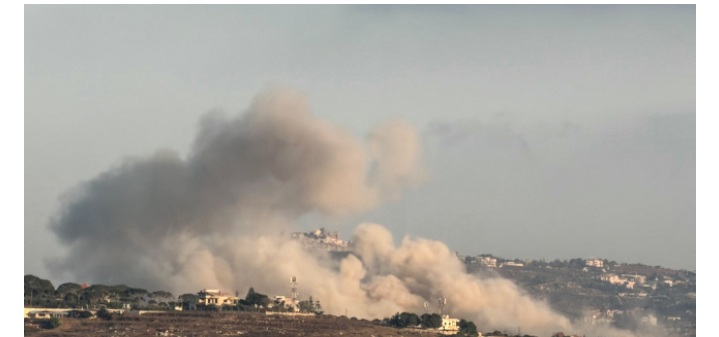
The conflict between the United States and Iran has intensified for a seventh consecutive night, with both sides exchanging strikes and issuing threats of further military action across the Middle East.
Iran has vowed a “full-scale offensive” if American attacks continue, while accusing U.S. forces of targeting civilian infrastructure, including an airport, railway station and bridges.
Tehran also claimed to have struck American military assets in Kuwait, Jordan and Bahrain.
Iran’s Revolutionary Guards said two oil tankers directed by what it described as “deceptive American intelligence agencies” exploded after hitting mines in the Strait of Hormuz, a claim the US military quickly denied.
The Guards also announced that they had stopped four ships attempting to pass through the strategic waterway, which is a major route for global oil shipments.
Major General Mohsen Rezaei, a senior military adviser to Iran’s Supreme Leader, warned that Tehran would move beyond limited retaliatory attacks if U.S. strikes persisted, saying Iran would no longer restrict itself to similar responses.
Meanwhile, the United States Central Command said American forces had carried out fresh strikes aimed at further weakening Iran’s military capabilities.
The latest escalation represents the most intense phase of hostilities since the two countries resumed attacks.
Iran accused Washington of hitting non-military targets, while the U.S. has maintained that its operations are focused on degrading Iran’s military strength.
The conflict began on February 28 after deadly U.S.-Israeli strikes on Iran, which responded by restricting traffic through the Strait of Hormuz and launching attacks against Israel and American interests across the Gulf region.
Iran’s state news agency, IRNA, reported that U.S. attacks killed three people and injured eight others in Hormozgan Province in southern Iran.
Iranian forces also claimed to have targeted American military facilities in Kuwait, Jordan and Bahrain, including ammunition depots, communication facilities and operational bases.
In Kuwait, Iranian forces reportedly targeted facilities at Al-Adiri and Ali Al-Salem military bases, while in Jordan, fuel storage facilities at the Al-Azraq base were said to have been hit.
Bahrain’s Sheikh Isa Air Base, described by Iran as a major US logistical centre in the region, was also listed among the targets.
Jordan’s military said it intercepted 10 Iranian missiles without casualties or significant damage, while Bahrain confirmed that air raid sirens were activated following the attacks.
Iran also accused the U.S. of striking power facilities and desalination infrastructure, leading to water supply disruptions in some southern communities.
Tehran urged citizens to reduce electricity consumption as pressure mounted on the national power grid.
The conflict has raised international concerns over the possibility of further expansion, with analysts warning that strategic infrastructure across the region is increasingly becoming part of the confrontation.
Efforts by mediators, including China and Pakistan, to encourage both sides to return to negotiations have continued, with calls for an end to hostilities and a diplomatic solution.
Meanwhile, attacks and tensions around the Strait of Hormuz remained a major concern, as continued disruption in the waterway could affect global energy supplies.