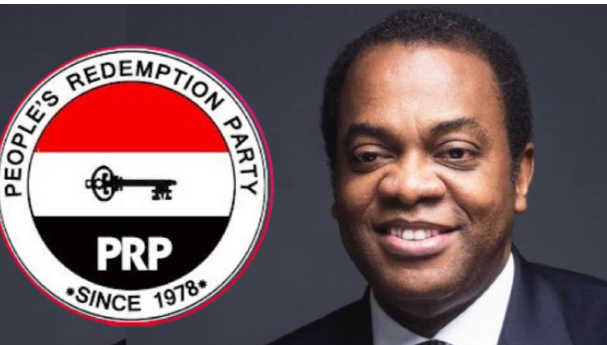
The presidential candidate of the Peoples Redemption Party (PRP) in the 2027 general election, Donald Duke, has called for a fundamental restructuring of Nigeria’s financial and economic architecture, arguing that high interest rates, excessive public borrowing and inefficient government spending are constraining growth and weakening businesses.
Duke, a former governor of Cross River State, said Nigeria needed an urgent combination of fiscal, financial, energy and institutional reforms to reduce the cost of doing business, restore investor confidence and put the economy on a sustainable growth trajectory.
Speaking during an interview, the PRP candidate identified the cost of credit as one of the biggest obstacles confronting businesses and economic expansion, warning that borrowing rates in the upper 30 per cent range were incompatible with sustainable growth.
“With interest rates in the upper 30s, you are undermining the economy. You cannot grow an economy with borrowing costs at that level,” he said.
Duke argued that Nigeria’s economic strategy should focus on creating a financial system capable of directing affordable capital towards productive activities.
He maintained that businesses could not expand, create sufficient employment or invest in new capacity when the cost of accessing funds remained prohibitively high.
“Affordable loans promote growth, while inflation in our case is largely driven by the high cost of government and poor economic management,” he said.
Duke wants spending priorities changed
Beyond monetary conditions, the former governor criticised what he described as misplaced priorities in public expenditure.
He argued that scarce government resources should be redirected towards sectors capable of raising productivity, strengthening human capital and improving the quality of life of citizens.
Duke specifically identified electricity, healthcare, education and the judiciary as areas where increased public investment could produce wider economic benefits.
He said spending in these sectors would have effects beyond their immediate beneficiaries by improving the environment in which businesses operate and attracting new investment.
“Strengthening these critical sectors would have a multiplier effect on the economy by improving human capital, supporting businesses, attracting investments and creating an enabling environment for sustainable development,” he said.
According to him, Nigeria’s economic difficulties are not primarily the result of a lack of resources but of weaknesses in how those resources are managed.
He called for reforms to the country’s revenue mobilisation system, energy sector and justice administration, insisting that the right policy environment could unlock significant economic opportunities.
Energy security central to productivity
Duke placed particular emphasis on energy, describing reliable and affordable power as one of the most important requirements for economic transformation.
He argued that Nigeria’s energy resources, if properly developed and made accessible at competitive prices, could substantially reduce production costs and improve the competitiveness of local businesses.
“We are blessed with virtually every form of energy. Make energy available and affordable because that is the greatest stimulus for productivity,” he said.
He added that energy reform would need to be supported by prudent public expenditure, a more efficient tax system and a credible judicial system.
“Combine that with prudent public spending, an efficient tax system and a judiciary that inspires confidence, and Nigeria can unlock its enormous economic potential.”
The former governor’s proposals come as businesses continue to contend with high operating costs and restricted access to affordable financing, while policymakers face the difficult task of containing inflation without further weakening economic activity.
For Duke, monetary policy alone could provide a lasting solution.
He said fiscal discipline, affordable credit, reliable energy and institutional reforms must operate together if Nigeria is to achieve sustained growth.
On governance, Duke said his proposed economic reforms would be underpinned by a different approach to public appointments and institutional management.
Defending his record as Cross River governor, he said his administration focused on establishing institutions that could survive beyond the tenure of individual political leaders.
He said the same principle would guide his approach at the federal level if elected president in 2027.
Duke argued that political considerations should cease to dominate governance once elections have been concluded, insisting that competence and integrity should determine who occupies key public positions.
“Politics ends after the election. Governance begins with assembling the best hands to move the country forward,” he said.
He added that public appointments should be made on the basis of ability and character rather than political loyalty.
“Appointments should be based on competence and integrity, not political loyalty. Every public official must be committed to leaving the country better than they met it.”
Duke said rebuilding confidence in public institutions would be essential to attracting both domestic and foreign investment.
He identified an efficient tax system, dependable electricity and a judiciary capable of resolving commercial disputes promptly and credibly as critical elements of a functioning investment environment.
His argument is that investors require more than favourable economic projections before committing capital; they also need confidence that the rules will be clear, infrastructure will support production and disputes can be resolved without prolonged uncertainty.
Duke therefore proposed an economic model centred on investment and productivity rather than one heavily constrained by high costs, expensive credit and weak institutional capacity.
He said the ultimate objective of his proposed reforms would be to create an economy in which businesses could access affordable capital, households can participate meaningfully in economic activity and government spending produces measurable developmental returns.
For the PRP candidate, achieving that transformation would require moving beyond isolated policy interventions and adopting a coordinated approach that addresses Nigeria’s financial, fiscal, energy and institutional challenges simultaneously.