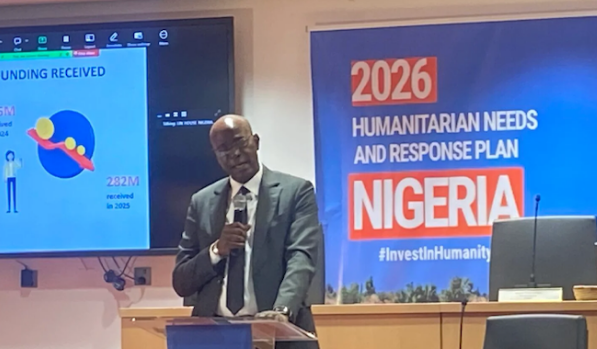
Nigeria’s 2026 humanitarian response remains significantly underfunded, with only $247.3 million secured against a requirement of $516.4 million, leaving a financing gap of about $269.1 million as millions of vulnerable people continue to face the effects of conflict, displacement, hunger and other emergencies.
The latest funding data from the United Nations Office for the Coordination of Humanitarian Affairs (OCHA) Financial Tracking Service, obtained by Hensard Times showed that the amount received by June 22 represented approximately 47 per cent of the country’s humanitarian funding requirement for the year.
Under the 2026 Humanitarian Needs and Response Plan (HNRP), humanitarian agencies require $516.4 million to provide assistance to about 2.25 million people identified as being in need of humanitarian support.
Of the $247.3 million recorded as humanitarian funding for Nigeria, $232.8 million was channelled through the HNRP, while approximately $5.8 million was allocated to humanitarian activities outside the plan.
Although the response remains substantially underfunded, the latest figures indicate a marked improvement in donor contributions compared with the first quarter of the year.
OCHA data showed that funding coverage stood at about 33 per cent at the end of March before gradually increasing to 47 per cent by June 22.
Funding channelled through the humanitarian plan rose from $173.6 million on March 30 to $192.8 million by April 27.
It subsequently climbed to $199.9 million on May 4, $214.6 million on May 26 and finally $232.8 million by June 22.
That represents an increase of $59.2 million, equivalent to about 34 per cent, in less than three months.
Despite the improvement, however, the available funding remains insufficient to implement the full humanitarian plan, leaving aid organisations dependent on additional contributions from international donors and other funding sources.
North-east remains major pressure point
The funding challenge comes as Nigeria continues to contend with protracted humanitarian crises, particularly in the North-east, where years of insecurity have displaced communities and created persistent food, shelter, health and protection needs.
The combination of insecurity, displacement, food insecurity and malnutrition has continued to place pressure on humanitarian operations, while a broader decline in international humanitarian financing has made it increasingly difficult for aid agencies to respond to all identified needs.
The funding shortfall consequently raises concerns about the ability of humanitarian organisations to sustain assistance to vulnerable communities throughout the year.
The United Nations and humanitarian partners have repeatedly highlighted the interconnected nature of the crises confronting affected populations, with insecurity contributing to displacement and disrupting livelihoods, while food insecurity and malnutrition deepen the vulnerability of displaced and host communities.
2026 appeal significantly lower than 2025
The current funding position also comes against the backdrop of a significantly larger humanitarian appeal in the previous year.
According to OCHA’s funding data, Nigeria required approximately $910.2 million for its humanitarian response in 2025 but received only about $321.5 million.
The 2026 requirement of $516.4 million is therefore substantially lower than last year’s appeal.
The reduction reflects a more targeted humanitarian response focused on the most critical needs and the populations considered most vulnerable, rather than indicating that Nigeria’s humanitarian challenges have disappeared.
Yet, even with the lower requirement, less than half of the funding needed for the 2026 response had been secured by June 22.
This means humanitarian agencies still need to mobilise roughly $269 million to fully finance the current response plan.
Nigeria Humanitarian Fund remains key mechanism
OCHA said the Nigeria Humanitarian Fund, established in 2017, remains an important mechanism for supporting humanitarian operations in the country.
The fund provides flexible financing intended to help humanitarian partners respond to urgent and critical needs, particularly where conventional funding arrangements may not provide resources quickly enough.
The latest figures showed that donor support for Nigeria has improved as the year has progressed, but the pace of funding remains insufficient to close the gap.
Among the countries and institutions contributing to Nigeria’s humanitarian response are Switzerland, Germany, Qatar, Japan, Canada, Türkiye, Saudi Arabia, the European Commission and Sweden, among others.
For humanitarian organisations, the remaining shortfall is more than a financial statistic. It represents a constraint on the scale and reach of assistance available to people already affected by violence, displacement, hunger and other emergencies.
With only about 47 per cent of the 2026 requirement funded midway through the year, humanitarian agencies face continued pressure to secure additional international and domestic resources if they are to deliver the assistance planned for the 2.25 million people targeted under the response plan.
The funding figures are therefore likely to reinforce calls for greater support for humanitarian operations in Nigeria, particularly as prolonged insecurity and food insecurity continue to generate needs faster than available resources can adequately address them.