The Democratic Republic of Congo has reported that at least 200 people are feared dead following a massive landslide at a mining site in the country’s conflict-hit eastern region.
In a statement issued on Sunday, the Congolese Ministry of Communication said the tragedy occurred at the Rubaya mine in North Kivu province, an area currently under the control of the M23 armed group.
The government expressed deep shock over the scale of the disaster, which it described as one of the deadliest mining accidents in recent times.
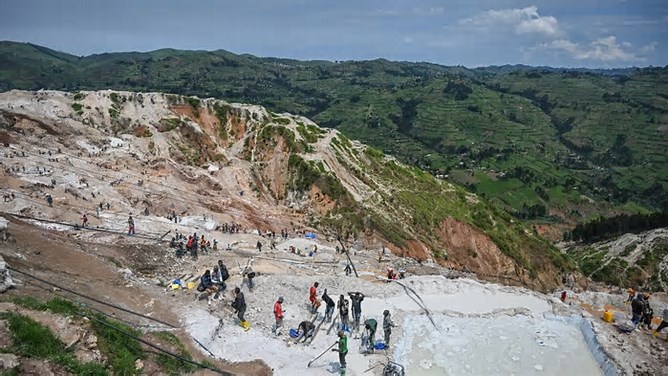
According to information obtained by humanitarian sources, a section of a hillside collapsed at the mine on Wednesday afternoon, burying scores of artisanal miners.
A second landslide reportedly struck the same location on Thursday morning, compounding the devastation.
Rubaya is located on steep, erosion-prone terrain characterised by unstable slopes and deep ravines.
During the rainy season, access roads often become impassable, making rescue efforts extremely difficult.
Thousands of miners work daily in the area using rudimentary tools and minimal protective equipment.
The M23-appointed governor of North Kivu, Eraston Bahati Musanga, who visited the site on Friday, said at least 200 bodies had been recovered from the debris, though he did not provide an exact casualty figure.
Independent verification of the death toll has been hampered by the breakdown of phone networks and the absence of state authorities and civil society groups, many of whom fled when the armed group took control of the area.
Humanitarian officials said injured survivors were rushed to nearby health facilities that lack adequate equipment and personnel.
Information from the site has continued to arrive slowly through informal channels, including motorbike couriers moving between affected communities.
The Rubaya mine is a major source of coltan, a mineral essential for the production of electronic devices such as mobile phones and laptops.
The mine is estimated to supply between 15 and 30 percent of global coltan demand.
Since resurfacing in 2021, the M23 group has seized large swathes of mineral-rich territory in eastern Congo, capturing Rubaya in April 2024.
United Nations experts say the group operates a parallel administrative system at the mine and earns hundreds of thousands of dollars monthly through taxation of mineral production.
Kinshasa has accused Rwanda of backing the militia and benefiting from the illegal exploitation of Congo’s resources, allegations Kigali has repeatedly denied.
The Congolese government said all mining and commercial activities in Rubaya were officially banned in February 2025, yet significant quantities of minerals continue to be extracted and transported out of the country.
Calling on the international community to recognise the gravity of the disaster, the government blamed the tragedy on armed occupation and what it described as an organised system of resource looting in the region.