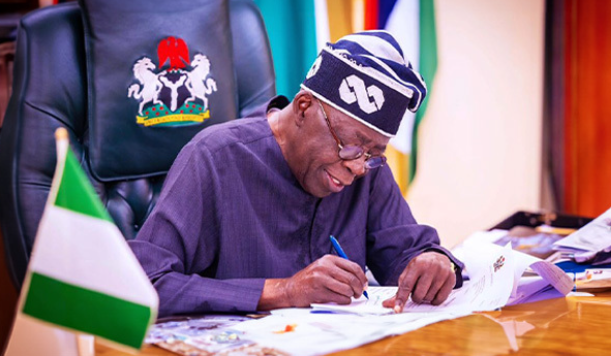
President Bola Tinubu has signed into law the 2026 Appropriation Bill, approving a total expenditure of N68.32 trillion for the fiscal year.
The president also assented to a separate measure extending the implementation of the 2025 budget, shifting its deadline from March 31, 2026, to June 30, 2026.
According to details released by the presidency, the approved budget includes N4.799 trillion for statutory transfers and N15.8 trillion allocated to debt servicing.
Recurrent expenditure is projected at N15.4 trillion, while a significant N32.2 trillion has been set aside for capital projects under the development fund.
Officials said the structure of the budget reflected a deliberate push toward infrastructure and long-term economic growth, with capital spending accounting for roughly half of the total allocation.
The administration stated that the spending plan is designed to promote economic stability, strengthen national security, and drive inclusive development.
It added that the allocations strike a balance between mandatory obligations, debt commitments, and investments aimed at improving productivity and living standards.
The newly signed amendment allows for the continued implementation of the capital component of the 2025 budget until the end of June 2026.
The government said the extension is intended to ensure the completion of ongoing infrastructure and development projects across the country.
It is also expected to give Ministries, Departments, and Agencies (MDAs) more time to fully utilise allocated funds and improve project delivery outcomes.
President Bola Tinubu has directed all government agencies to ensure prudent use of public funds, emphasising transparency, efficiency, and value for money.
He also commended the National Assembly for its swift consideration and passage of the budget, highlighting the importance of cooperation between the executive and legislative arms of government.
The government indicated that part of the budget would be financed through external borrowing, following approval of a foreign loan plan exceeding $21 billion to cover the fiscal gap.
The administration also pledged to deepen fiscal reforms, boost revenue generation, and expand social protection programmes.
The approved budget represents a N9.85 trillion increase over the initial proposal submitted to lawmakers and is significantly higher than the 2025 budget.
Earlier projections had set key assumptions including oil production of 1.84 million barrels per day and an exchange rate of N1,400 to the U.S. dollar.
Addressing lawmakers previously, President Bola Tinubu emphasised the need for increased investment in security, stressing that spending in the sector must yield measurable results.
He also highlighted agriculture as a central pillar of the budget, noting that food security remains closely tied to national stability.
Planned investments include support for mechanisation, irrigation, storage, and agro-processing value chains.
Despite the ambitious projections, recent budgets in Nigeria have faced criticism over poor implementation and delays in fund releases.
However, government officials insisted that the 2026 budget is structured to consolidate ongoing reforms and accelerate development outcomes.
They describe it as a framework aimed at strengthening resilience and ensuring broader economic benefits for citizens.