The Economic Community of West African States (ECOWAS) has stepped up efforts to deepen regional economic integration and strengthen private sector participation through renewed plans to operationalise the ECOWAS Business Council (EBC), a platform designed to drive investment, trade, and industrial development across the sub-region.
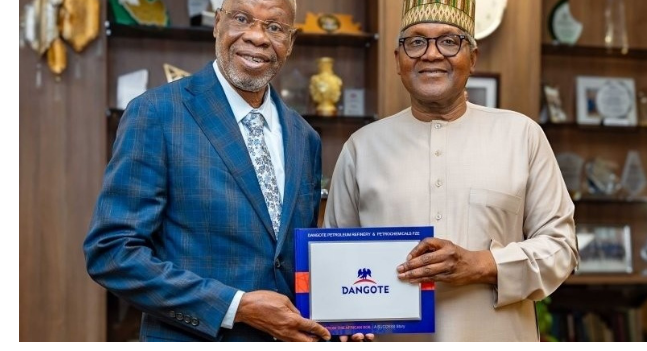
The renewed commitment was highlighted during a high-level working visit by senior ECOWAS Commission officials to the Chairman of the ECOWAS Business Council, Aliko Dangote, at the Dangote Group headquarters in Lagos.
The delegation included the ECOWAS Commissioner for Economic Affairs and Agriculture, Dr. Kalilou Sylla, and the Commissioner for Internal Services, Dr. Habib Bappah, alongside members of the Technical Working Group for the council.
The commission said the engagement focused on accelerating the full activation of the Business Council, which is intended to serve as a key private-sector-led platform for collaboration between governments and businesses in advancing ECOWAS economic integration goals.
According to the Commission, the initiative marks an important step toward placing the private sector at the centre of regional economic transformation, job creation, industrialisation, and sustainable growth.
During the meeting, ECOWAS representatives emphasised the need for stronger private sector involvement in unlocking the economic potential of West Africa, particularly by improving competitiveness, expanding intra-regional trade, and attracting investment.
The ECOWAS Business Council is expected to function as a bridge between policymakers and the business community, offering practical solutions to long-standing barriers affecting trade, investment, and industrial expansion across the 15-member bloc.
Despite decades of integration efforts, trade within West Africa remains relatively low, with analysts attributing this to poor infrastructure, multiple border delays, non-tariff barriers, policy inconsistencies, and limited private sector input in regional policymaking.
Observers said a fully operational Business Council could help address these challenges by promoting structured dialogue between governments and businesses while pushing reforms that improve the ease of doing business across member states.
The appointment of Aliko Dangote as Chairman of the ECOWAS Business Council is widely viewed as a strategic decision aimed at leveraging his experience as one of Africa’s leading industrialists with investments spanning multiple sectors and countries.
Dangote’s business footprint includes cement, fertiliser, petrochemicals, sugar, and logistics, making him a major figure in discussions around regional trade and industrial development.
The initiative also aligned with broader continental efforts under the African Continental Free Trade Area (AfCFTA), which aims to create a unified African market of over 1.4 billion people by boosting trade and economic cooperation across the continent.
For years, ECOWAS has pursued the vision of a borderless West Africa where goods, services, capital, and people move freely.
However, progress has been slowed by infrastructure gaps, economic disparities, and uneven policy implementation among member states.
The Lagos meeting is therefore seen as a significant step toward operationalising the council and advancing ECOWAS’ broader goal of making the private sector a central driver of regional prosperity and sustainable development.